
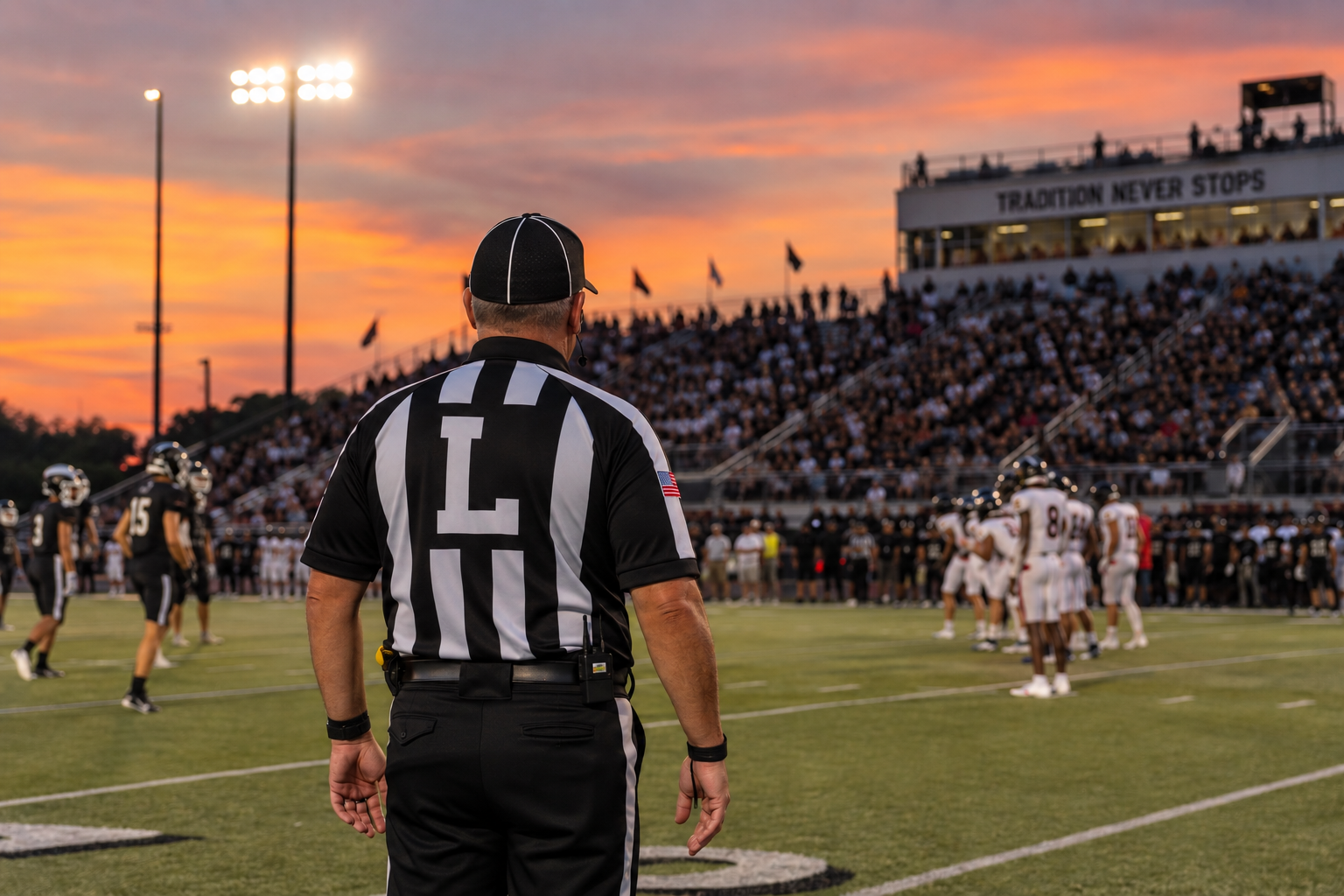
A Day in the Life of a Texas High School Football Referee: Friday Night Under the Lights
There is something different about Friday nights in Texas.
The stadium lights come on. The band starts playing. The smell of food from the concession stand fills the air. Students pack into the stands, parents find their seats, and two football teams prepare for a game they have been thinking about all week.
But while everyone else is getting ready to watch the game, I’m getting ready to officiate it.
Being a high school football referee in Texas is about much more than putting on a striped referee shirt and throwing a penalty flag. A typical Friday night starts hours before kickoff and usually doesn’t end until long after the stadium lights have been turned off.
The Day Starts Before the Game
One thing many fans don’t realize is that most high school football officials have regular jobs.
We are teachers, business owners, police officers, firefighters, accountants, salespeople, retirees, and professionals from just about every background imaginable.
So on a Friday morning, I’m not waking up as a football referee. I’m waking up and going to work.
But somewhere in the back of my mind, I’m already thinking about that night’s game.
Where am I working?
What position am I officiating?
Who is on my crew?
How long is the drive?
And maybe the most important question of all:
Did I pack everything?
Packing My Football Referee Bag
A football official learns quickly that forgetting one small piece of equipment can create a big problem.
Before leaving for the stadium, I go through my referee bag.
My gear usually includes my striped football referee shirt, black officiating pants or shorts, referee hat, penalty flags, bean bags, whistles, down indicator, game cards, pencils, belt, socks, officiating shoes, and other accessories I may need during the game.
Then I check everything again.
Texas weather adds another challenge.
Early-season high school football games can still feel like the middle of summer. Temperatures may be high even as the sun goes down, and the humidity can make your uniform feel soaked before the opening kickoff.
That means hydration and preparation are just as important as having the right officiating equipment.
Driving to the Stadium
For a typical 7:00 p.m. kickoff, I want to arrive well before the fans fill the parking lot.
In a place like Houston, that also means planning for traffic.
A stadium that looks 30 minutes away can suddenly become an hour-long trip on a Friday afternoon.
Once I arrive, I find the officiating locker room and meet up with the rest of the crew.
That’s when game night really begins.
The Pregame Conference
A good football officiating crew doesn’t simply walk onto the field and hope everything works out.
We have a pregame meeting.
We talk about responsibilities, positioning, communication, unusual situations, penalties, clock management, kicking plays, goal-line coverage, and how we are going to work together throughout the game.
Football officiating requires teamwork.
One official cannot see everything happening on the field.
Each member of the crew has specific responsibilities. When everyone handles those responsibilities correctly, the crew begins to operate almost like one unit.
The best officiated games are often the ones where nobody notices the officials.
Walking Under the Friday Night Lights
Walking onto the field is still one of my favorite parts of officiating.
You come out of the locker room and suddenly hear everything.
The marching band.
The cheerleaders.
The student section.
The coaches.
The players.
The public-address announcer.
There is an energy surrounding Texas high school football that is difficult to describe unless you have experienced it from field level.
Before kickoff, we take care of our pregame responsibilities. We inspect the field, communicate with the coaches, confirm equipment and game information, and handle the coin toss.
Then it’s time.
Whistle ready.
Penalty flag ready.
Eyes focused.
Kickoff.
Every Play Requires Concentration
From the stands, football may look like a series of simple plays.
For an official, every snap involves a long list of responsibilities happening almost simultaneously.
What is my key?
Was the formation legal?
Did a player hold?
Was there illegal contact?
Did the runner step out of bounds?
Did the receiver maintain possession?
Where should the football be spotted?
Should the game clock continue running?
Was the quarterback beyond the line of scrimmage?
And officials sometimes have only a second or two to process everything.
There usually isn’t a replay booth to bail you out in a high school football game.
You see the play.
You make the decision.
Then you have to move on to the next play.
Everyone Has an Opinion
There is another reality of football officiating.
Someone is probably going to disagree with you.
Sometimes it’s a coach.
Sometimes it’s a player.
Sometimes it’s a fan sitting 60 yards away who somehow believes he had a better view than anyone on the field.
That comes with the job.
As an official, I cannot officiate based on crowd reaction.
I call what I see.
I communicate with my crew.
I remain professional.
Most importantly, I cannot allow the previous play to affect the next one.
If I make a mistake — and every official eventually will — I have to reset mentally.
The next snap deserves my complete attention.
Halftime Isn’t Exactly a Break
When the teams head into their locker rooms at halftime, our crew does the same.
But we aren’t simply sitting around relaxing.
We talk about what happened during the first half.
Were there unusual plays?
Are there formations we need to watch?
Do we need to adjust our positioning?
How is our communication?
Is there something one team is doing that the entire crew needs to understand?
Good officiating crews constantly evaluate themselves.
Even experienced football referees are always learning.
Before long, someone tells us that halftime is almost over.
We grab our hats and whistles.
Back outside we go.
The Fourth Quarter
By the fourth quarter, you have probably been standing, running, backpedaling, and concentrating for several hours.
Your legs know it.
But this is also when officiating can become even more important.
A close Texas high school football game in the fourth quarter can be intense.
Every yard matters.
Every second matters.
Every decision matters.
The crowd gets louder.
Players become more emotional.
Coaches become more animated.
As officials, we have to do the opposite.
We have to become calmer.
Our mechanics have to remain sharp.
Our communication has to remain strong.
Our concentration with two minutes remaining has to be just as good as it was on the opening kickoff.
The Final Whistle
Eventually, the game clock reaches 0:00.
We confirm that the game is over and leave the field together.
Then comes one of the most valuable parts of the night: the postgame conversation.
We talk about the game.
What did we do well?
What could we have done differently?
Were there plays we need to review in the rulebook?
Did our mechanics put us in the best possible position?
There is always something to learn.
Then I change clothes, pack my officiating equipment back into my bag, and begin the drive home.
Depending on where the game was played, I may not walk through my front door until 11:00 p.m. or later.
It has been a long day.
I’m tired.
But chances are, I’m already thinking about the next game.
Why Become a High School Football Referee?
People sometimes ask why anyone would want to become an official.
You run around in the Texas heat.
You give up Friday nights.
You drive all over your area.
And occasionally, thousands of people disagree with you at exactly the same time.
So why do it?
Because you get one of the best seats in the stadium.
Because you become part of a team.
Because you develop friendships with other officials that can last for decades.
Because officiating keeps you connected to a sport you love.
And most importantly, because high school sports cannot happen without officials.
Every Friday night across Texas, student-athletes have an opportunity to compete because officials are willing to put on the uniform and step onto the field.
The players may never remember my name.
The fans probably won’t either.
That’s perfectly fine.
If the teams were able to compete, the game was handled professionally, and our crew walked away knowing we gave our best effort, then we did our job.
Interested in Becoming a Football Official?
You do not have to know everything about football before you begin.
Every experienced referee once worked a first game.
What matters is being willing to learn, showing up prepared, accepting constructive feedback, and improving each week.
Officiating is a great way to stay involved with football, earn extra income, stay active, meet new people, and give back to high school athletics.
And when you are ready to step onto the field, having dependable equipment makes a difference.
Get Game-Day Ready with Officials Depot
At Officials Depot, we help new and experienced football officials get ready for game day with the apparel and equipment they need.
Shop football referee shirts, officiating pants and shorts, referee hats, penalty flags, bean bags, whistles, accessories, starter equipment, and more.
Whether you are preparing for your first freshman game or another Friday night varsity assignment, make sure your referee bag is ready before kickoff.
Shop Football Referee Equipment at Officials Depot and get ready for your next assignment.
Because when those Friday night lights come on, the teams aren’t the only ones who need to be ready.